Frequently Asked Questions About Hypnotherapy: How It Works, Benefits and More…
What You Need to Know About Hypnotherapy:
A Hypnotherapist’s Answers to Your Common Questions.
-
At HeadFirst Hypnotherapy, Solution-Focused Hypnotherapy combines two forms of therapy: talking therapy (to be more specific “Solution-Focused Brief Therapy - SFBT”) and hypnosis. It’s a quick, practical way to address thought patterns, emotions or behaviours that are holding you back in life.
Solution-Focused Hypnotherapy believes you already have the necessary resources to find solutions and to make positive changes in your life. Rather than dwelling on the problem, I help you develop your strengths to make your goals a reality.
-
At HeadFirst Hypnotherapy, Hypnotherapy works by inducing a natural shift in conscious awareness known as a trance. In this state, you feel more focused and receptive to positive suggestions that you have chosen beforehand.
Trance / hypnosis removes distractions and critical thinking, allowing your unconscious mind to engage with therapeutic tools effectively.
This heightened focus helps bypass the rational mind's resistance, enabling beneficial changes to take root without the usual doubts or objections.
Hypnotherapy leverages the trance state to promote mental and emotional wellbeing through targeted, positive reinforcement.
I work with clients from my therapy room in Upper Heyford, nr Bicester, Oxfordshire and also online nationally and internationally.
-
At HeadFirst Hypnotherapy, I work in a way that is informed by existing research into hypnosis, neuroscience, and solution-focused approaches.
There is a growing body of scientific evidence suggesting that hypnotherapy can be a supportive approach for a range of emotional and physical concerns, including anxiety, pain management, sleep difficulties, and behaviour change.
Research has shown that hypnosis can influence attention, perception, and emotional regulation, and brain-imaging studies suggest that the brain responds differently when a person is in a hypnotic state compared to ordinary waking awareness.
Solution-Focused Hypnotherapy (SFH), as practised at HeadFirst Hypnotherapy, combines the established use of hypnosis with principles from Solution-Focused Brief Therapy and contemporary neuroscience. This approach focuses on how the brain processes stress and change, supporting clients in developing calmer, more helpful patterns of thinking.
While research in this area continues to develop, existing studies support the use of hypnosis and solution-focused approaches as part of modern, evidence-informed therapeutic support.
-
At HeadFirst Hypnotherapy, I use Solution-Focused Hypnotherapy to support a wide range of emotional and psychological challenges by helping clients focus on positive change, rather than becoming stuck analysing problems.
Solution-Focused Hypnotherapy can be supportive for concerns such as anxiety, stress, low mood, sleep difficulties, overthinking, confidence issues, fears and phobias, IBS, and unwanted habits.
I also work with clients around areas such as motivation, self-esteem, emotional resilience, and sexual wellbeing, using a calm, practical, and future-focused approach.
Rather than dwelling on the past, Solution-Focused Hypnotherapy as practised at HeadFirst Hypnotherapy focuses on building strengths, developing effective coping strategies, and supporting you to move towards the future you want.
I offer Solution-Focused Hypnotherapy from my therapy room in Upper Heyford, near Bicester in Oxfordshire, as well as online for clients across the UK and internationally.
-
At HeadFirst Hypnotherapy, Solution-Focused Hypnotherapy is offered as a brief, forward-focused therapeutic approach. It works by supporting the brain to develop new, more helpful patterns of thinking and responding, drawing on principles of neuroplasticity — the brain’s ability to change and adapt over time.
Many clients notice positive changes early in the process, sometimes not only in the area they initially sought support with, but also in other aspects of their wellbeing and day-to-day life.
The number of sessions varies depending on your individual goals and circumstances. While some people choose to attend for just a few sessions, others prefer a longer period of support. As a general guide, most clients I work with at HeadFirst Hypnotherapy attend between 6–12 sessions.
We review progress together as we go, and you remain fully in control of how long you choose to continue.
-
At HeadFirst Hypnotherapy, each hypnotherapy session lasts approximately 50–60 minutes. This allows enough time for a calm check-in, therapeutic work, and space to reflect before the session ends.
Session length is designed to support focused, effective work without feeling rushed, while still fitting comfortably into everyday life.
While in this relaxed state, your attention becomes more inwardly focused, allowing therapeutic suggestions to support positive change and reinforce the solutions you are working towards.
-
Sessions usually take place weekly, particularly at the beginning, as this helps build momentum and continuity. However, this can vary depending on your goals, availability, and personal circumstances.
Some people choose to space sessions further apart over time, or move to occasional follow-up sessions once they feel more settled. We’ll review progress together and adjust the frequency in a way that feels supportive and manageable for you.
At HeadFirst Hypnotherapy, the pace of sessions is always collaborative and flexible rather than fixed.
-
At HeadFirst Hypnotherapy, sessions begin with a calm, non-invasive talking phase focused on your preferred future, rather than analysing problems.
We explore what you would like to be different, how you want to feel (for example, calmer or more confident), and agree achievable, forward-focused goals.This part of the session prioritises solution-focused thinking and practical strategies, helping your mind begin to move towards new, more helpful patterns of response.
Depending on your goals, this phase may draw on elements of Solution-Focused Brief Therapy (SFBT), alongside tools informed by Cognitive Behavioural Therapy (CBT) and Neuro-Linguistic Programming (NLP). This part of the session typically lasts around 30 minutes.
In the second half of the session, I gently guide you into a state of deep relaxation, often referred to as trance or hypnosis. You remain aware and in control throughout, either sitting comfortably or reclining if you prefer. This focused, relaxed state can be just as effective online as it is in face-to-face sessions.
While in this relaxed state, your attention becomes more inwardly focused, allowing therapeutic suggestions to support positive change and reinforce the solutions you are working towards.
-
After a session, many people feel calm, relaxed, or mentally clearer.
Others may simply feel normal and carry on with their day as usual - both experiences are completely fine.Sometimes you may notice small shifts in perspective, mood, or behaviour over time rather than immediately.
Change is often gradual and builds between sessions as your mind continues to integrate what you’ve worked on.
If anything unexpected comes up or you have questions after a session, you’re always welcome to raise these at your next appointment so we can reflect on them together.
-
At HeadFirst Hypnotherapy, hypnosis (sometimes referred to as trance) is described as a natural shift in conscious awareness that most people experience in everyday life.
It is a state of focused attention where you remain aware, present, and in control throughout.While in this focused state, your attention becomes more settled and inwardly directed, allowing your mind to concentrate on positive suggestions and therapeutic ideas that you have chosen to work with in advance.
This state of focused awareness can help quiet everyday distractions and habitual over-analysis, making it easier for the unconscious mind to engage with useful therapeutic tools - without the usual mental interruptions or self-doubt that can arise during normal waking thought.
-
While hypnotherapy is considered safe for many people, there are some situations where it may not be appropriate or where additional medical guidance is needed.
Hypnotherapy may not be suitable for individuals who are currently experiencing severe mental health conditions such as psychosis or schizophrenia, or for those in acute psychological crisis, including active suicidal thoughts or self-harm. Certain neurological conditions, some cardiac conditions (particularly if they are unstable or not well managed), and epilepsy may also require medical input before hypnotherapy can be considered.
If you are under the care of a GP, psychiatrist, or other medical or mental health professional, written consent may be required before therapy can begin. This is particularly important where there are cardiac conditions, blood pressure concerns, neurological conditions, or recent changes to medication.
At HeadFirst Hypnotherapy, suitability is always explored carefully during the Initial Consultation. This includes discussing your goals, relevant medical or mental health history, and whether hypnotherapy is an appropriate and safe option for you at this time.
Please note that some GP surgeries or healthcare providers may charge an administration fee for providing written confirmation or consent. I have no control over individual policies, and any associated costs are the responsibility of the client.
If hypnotherapy isn’t suitable, I will always aim to signpost you to more appropriate forms of support.
-
No — hypnotherapy is very different from stage or entertainment hypnosis.
Stage hypnosis is designed for performance and relies on volunteers playing along in a public setting. Therapeutic hypnotherapy, by contrast, is a private, professional process focused on your wellbeing and personal goals.
In sessions, you remain aware, in control, and actively involved throughout. Nothing is done to you — the work is collaborative and based on your consent and intention.
My approach at HeadFirst Hypnotherapy is calm, professional, and evidence-informed, and I’m trained to use hypnosis in a safe, ethical, therapeutic way rather than as a form of entertainment.
-
I provide hypnotherapy services for individuals aged 16 and above, encompassing both adults and adolescents.
For clients under 18, parental involvement is customary during the Discovery Experience/Initial Consultation. Subsequent sessions typically involve only the 16-17 year old.
Before any paid sessions commence, parents are required to sign my terms and conditions, along with a consent form.
-
Most people can experience some level of hypnosis, although how it feels can vary from person to person. Factors such as comfort, trust in the process, the ability to focus, and a willingness to engage all play a part.
Hypnosis isn’t something that’s done to you. It’s a natural, collaborative state that we move into together. Some people find that relaxed, focused state comes easily, while for others it develops more gradually — and both experiences are completely normal.
At HeadFirst Hypnotherapy, sessions always begin with a thorough consultation to explore what you’d like support with and to check that Solution-Focused Hypnotherapy is appropriate for you. I’ll explain how the process works and tailor the approach to suit your individual needs and pace.
-
Yes. At HeadFirst Hypnotherapy, I offer online hypnotherapy sessions alongside face-to-face appointments from my practice in Upper Heyford, near Bicester in Oxfordshire. This means you can choose the option that best fits your lifestyle and circumstances.
Online sessions allow you to access support from the comfort of your own home, removing the need for travel and making therapy easier to fit around everyday life. Many people find that being in a familiar environment helps them feel more at ease and focused during sessions.
The structure and professional standards of online sessions are the same as in-person work. You remain fully aware and in control throughout, and sessions are conducted in a calm, supportive, and confidential way.
Online hypnotherapy is a flexible and accessible option for adults, whether you’re based locally in Oxfordshire or further afield in the UK or internationally.
-
Yes, hypnotherapy is considered safe when delivered by a trained, qualified practitioner. It’s a natural, collaborative process that helps the mind access a calm, focused state, creating space for positive change through deep relaxation and solution-focused work.
You remain aware and in control throughout the process, and you cannot be made to do anything against your will. The experience is gentle, and you’re always encouraged to engage at a pace that feels right for you.
I adhere to professional standards, ethical guidelines, and insurance requirements to ensure your safety and wellbeing at every stage. We begin with a thorough Initial Consultation to explore your goals, assess suitability, and discuss any relevant health or medical history.
-
While hypnotherapy is safe for most people, there are some circumstances where it may not be suitable. These include:
Individuals currently experiencing severe mental health conditions (such as psychosis or schizophrenia)
People in psychological crisis (including suicidal thoughts or self-harm)
Certain neurological conditions
Some cardiac conditions, particularly those that are unstable or unmanaged, or if there have been recent changes in medication or blood pressure
Individuals with epilepsy (who should consult their doctor before starting hypnotherapy)
If you are under the care of a medical or mental health professional, written consent may be required before therapy can begin. This is particularly important for clients with cardiac conditions, blood pressure issues, or any other medical condition where your GP’s consent is needed. Please note that some GP surgeries or healthcare providers may charge an administration fee to write a letter or email confirming whether it is safe to undertake hypnotherapy. I have no control over individual policies, and it is the client’s responsibility to cover any associated costs.
If hypnotherapy isn’t suitable for you, I will always be happy to signpost you to more appropriate support. description
-
Solution-Focused Hypnotherapy may be a good fit if you’re looking for a practical, forward-focused way to support your emotional wellbeing, rather than spending long periods analysing the past.
Many people choose hypnotherapy to support concerns such as anxiety, stress, low mood, overthinking, confidence issues, or unwanted habits. Being open to talking about your goals and willing to engage in a calm, guided process can help you get the most from this approach.
At HeadFirst Hypnotherapy, the best way to explore whether hypnotherapy is right for you is by booking an Initial Consultation.
This session provides space to discuss what you’re hoping to change, understand how I work, and assess whether Solution-Focused Hypnotherapy is appropriate and suitable for you at this time.
-
That’s a very common concern, and it’s understandable to wonder what the experience will be like.
In hypnotherapy, you’re not placed into a deep or unconscious state. Instead, sessions involve a calm, relaxed, and focused state of awareness — similar to becoming absorbed in a book, music, or your thoughts.
You remain aware of what’s happening at all times and stay fully in control throughout the process. You won’t say or do anything you don’t want to, and you can choose to engage at a pace that feels comfortable for you.
At HeadFirst Hypnotherapy, sessions are designed to feel safe, respectful, and supportive, with your comfort and autonomy prioritised at every stage.
-
Yes. Free and convenient parking is available at both practice locations.
In Upper Heyford (near Bicester, Oxfordshire), there is free off-street parking available on my driveway, making arrival simple and stress-free.
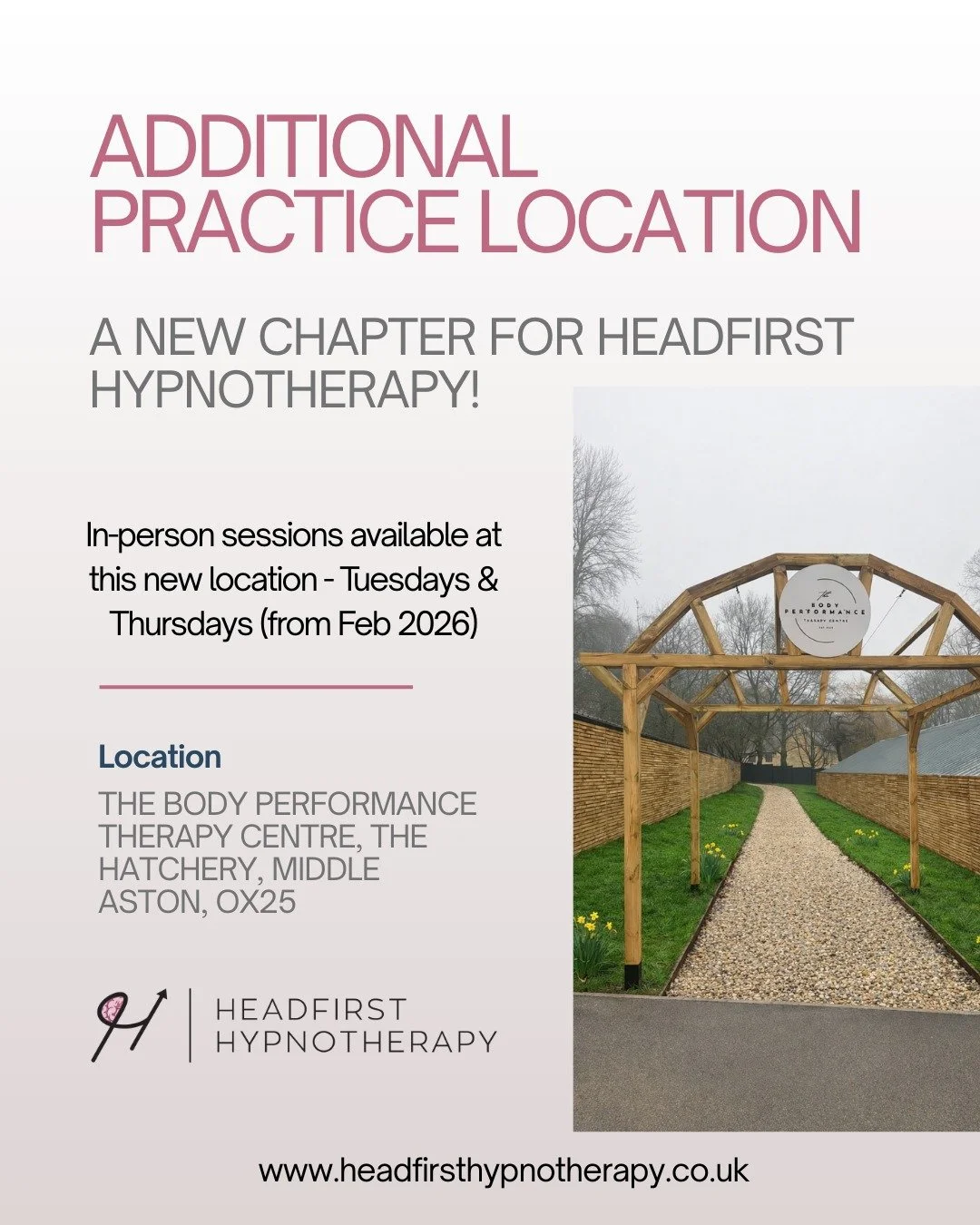
At The Hatchery in Middle Aston, there is also free and convenient on-site parking available.
Full directions and clear instructions are sent when you book an in-person hypnotherapy session, so you know exactly where you’re going and what to expect.
-
You don’t need to wear or bring anything special. Comfortable clothing that allows you to relax easily is ideal, whether you’re attending in person or online.
If you’re coming to an in-person session, you’re welcome to bring a bottle of water if you wish. For online sessions, it can help to choose a quiet, private space where you won’t be disturbed and where you can sit or recline comfortably.
The most important thing is that you feel at ease - everything else will be guided during the session.
-
No, I don’t offer a money-back guarantee.
At HeadFirst Hypnotherapy, I work in a way that is ethical, transparent, and client-led. Like all forms of therapy, hypnotherapy is a collaborative process.
Change depends on a range of individual factors, including your goals, readiness for change, and engagement with the process. Every client is different, and outcomes can vary.
Some people notice shifts relatively early, while for others progress is more gradual and unfolds over time. Therapy isn’t something that’s done to you - it’s something we work on together, at a pace that feels right for you.
What I can always commit to is working with care, professionalism, and honesty, and reviewing progress with you as we go, so you feel informed and supported throughout.
-
Yes, absolutely. At HeadFirst Hypnotherapy in Upper Heyford, near Bicester in Oxfordshire, clients can choose to mix in-person and online hypnotherapy sessions if that suits their circumstances. This flexibility can make it easier to stay consistent with sessions while fitting therapy around work, travel, or other commitments.
Some people prefer to attend sessions in person when they can, while using online sessions at other times for convenience. Both formats follow the same professional structure and are approached with the same care and attention.
We’ll agree together what works best for you and can adapt this over time if your needs or availability change.
-
Yes. Some clients choose to continue with occasional or ongoing hypnotherapy sessions once their initial block of work has finished.
At HeadFirst Hypnotherapy, these sessions are sometimes used as a way to maintain progress, reflect on changes, and reinforce helpful ways of thinking or coping, particularly during busy or challenging periods. Others find them useful as a regular check-in to support emotional wellbeing and resilience over time.
Ongoing or top-up sessions are always optional and flexible. We’ll review what feels useful for you and agree together whether occasional follow-up sessions make sense, based on your goals and circumstances.
-
Not usually. Solution-Focused Hypnotherapy doesn’t require detailed exploration of your childhood or past experiences unless you choose to share something you feel is relevant.
The focus is on where you are now and what you would like to be different moving forward. Rather than analysing past events, sessions centre on your current experience, your goals, and small, achievable steps towards change.
At HeadFirst Hypnotherapy, I work in a forward-focused way, helping you develop practical strategies and more helpful ways of responding in the present, so you can move towards the future you want at your own pace.
-
There’s no special preparation required. You don’t need to rehearse what to say or try to relax in advance.
It can be helpful to arrive with a general sense of what you’d like support with, but we’ll explore this together during your Initial Consultation. I’ll explain how the process works, answer any questions you have, and make sure the approach feels right for you.
At HeadFirst Hypnotherapy, sessions are designed to feel calm, supportive, and unpressured - you’re guided every step of the way.
-
It’s a fair question - and one many people ask.
While hypnotherapy can be a powerful and supportive approach, meaningful change usually takes place over time rather than in a single session. Change tends to be a process that involves reflection, practice, and gradually developing new ways of thinking and responding.
At HeadFirst Hypnotherapy, my role is to guide and support this process by providing a calm, structured space, practical tools, and solution-focused strategies informed by how the brain learns and adapts. Each session builds on the last, allowing change to become more settled and sustainable.
Some people notice shifts early on, while for others progress is more gradual. What matters most is finding a pace that feels right for you and supports lasting change, rather than aiming for a quick fix.
-
Access to hypnotherapy through the NHS is currently very limited. While it may be offered in some specialist or local services, it isn’t widely available as a standard NHS treatment.
You’re welcome to discuss this option with your GP or healthcare provider, as availability can vary depending on location and individual circumstances. In many cases, however, people choose to access hypnotherapy privately.
At HeadFirst Hypnotherapy, I work in independent practice, which is how most qualified hypnotherapists in the UK currently offer their services.
-
HeadFirst Hypnotherapy works from practice locations in Upper Heyford and Middle Aston, Oxfordshire.
In Upper Heyford (near Bicester, OX25), I offer in-person sessions from a comfortable, private therapy space, with free off-street parking available on my driveway.
I also work from The Hatchery in Middle Aston, which offers a calm, professional setting with free and convenient on-site parking.
Online hypnotherapy sessions are also available for those who prefer to work remotely.
-
I’m not registered directly with health cash plan providers, so I don’t submit claims on a client’s behalf. However, many clients who have workplace health cash plans or employee benefit schemes are able to claim back part of their session fees themselves.
At HeadFirst Hypnotherapy, I provide a full invoice . which includes the information typically required for reimbursement under health cash plans or wellbeing benefit schemes.
Coverage varies between providers and employers, so it’s important to check with your health plan provider or HR team to confirm whether hypnotherapy is included under your policy and to understand any limits that may apply. Some plans place caps on claims or group hypnotherapy under specific wellbeing or complementary therapy categories.
If your provider requires specific details to be included on the invoice - such as professional memberships or reference information - I’m happy to include these where appropriate.
-
HeadFirst Hypnotherapy is based in Upper Heyford, near Bicester in Oxfordshire, where sessions take place in a calm, private garden therapy room at my home.
The room has flat access with no steps from the driveway, making it easy to enter on foot. Please note that the Upper Heyford therapy room is not wheelchair accessible.
I also work from The Hatchery in Middle Aston, which offers a fully wheelchair-accessible setting with step-free access and convenient on-site parking.
If you have any accessibility questions or specific requirements, you’re very welcome to get in touch before booking so we can make sure the setting is right for you.
-
This is a very common concern. Hypnosis doesn’t always feel dramatic or obvious, and there’s no single “right” way for it to feel.
Some people notice a deep sense of relaxation or focus, while others simply feel calm and attentive. Even if it feels subtle, the process can still be effective. Hypnosis isn’t about switching your mind off - it’s about gently focusing your attention in a helpful way.
At HeadFirst Hypnotherapy, there’s no expectation to “do it right” or feel a certain way. I guide the process and adapt it to you, so you can engage in whatever way feels natural.

PROFESSIONAL BODIES



Hypno-Way? (Blog)
I’d love for you to follow me on Instagram!